From Pixels to Perfect Steak
How Gambit’s vision system learned to cook steak.
Every System Needs a Benchmark
Ours was steak. Predictable, measurable, and surprisingly hard. It was the perfect first test for Gambit.

Steak x Motion Classifier.
Teaching Gambit to See
A core part of Gambit’s brain is computer vision. Using RGB and thermal cameras, it doesn’t just watch your pan — it interprets it. Gambit recognizes what’s happening as food cooks: when crust forms, butter foams, or oil starts to smoke.
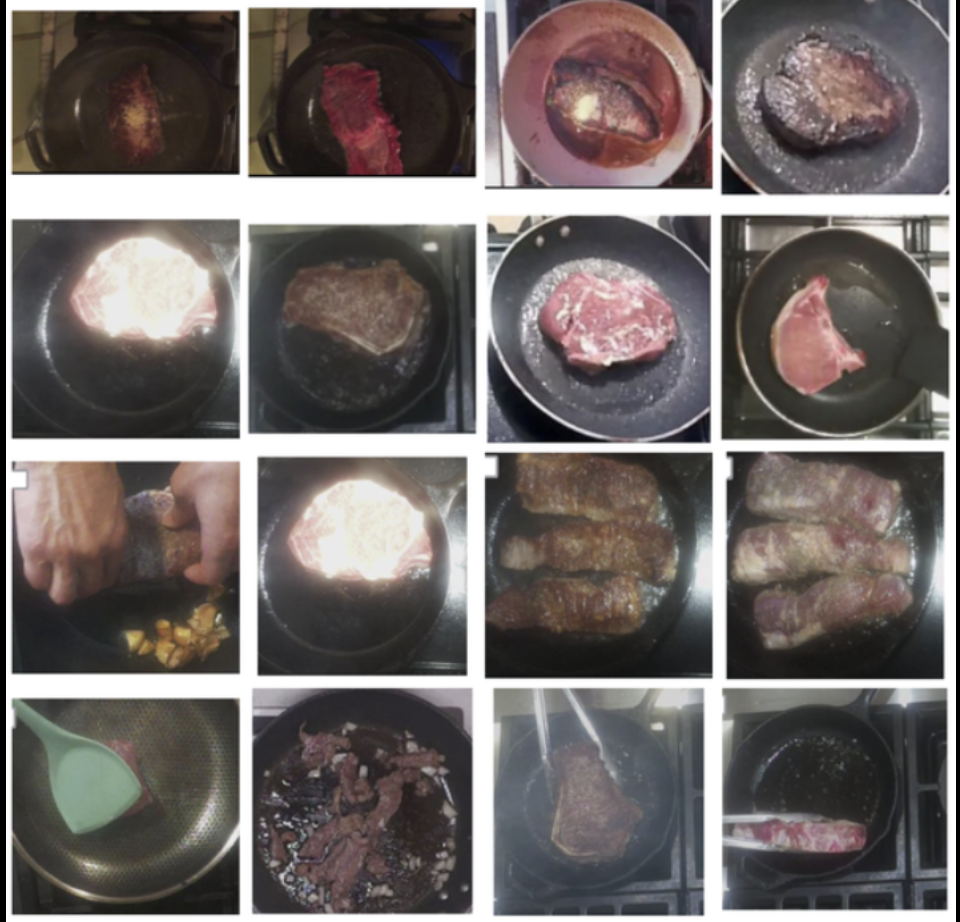
To train “Steak AI,” we built a massive dataset of real steaks — different cuts, marbling, lighting, and doneness levels — and labeled much of it frame by frame. Then we taught the model to combine that visual understanding with cues like lighting, temperature, and time, making it smarter about how food actually cooks.

Building Steak AI
Collected a large training set of steak images
Added non steak images to trick the computer
Labeled cut, marbling, surface color, and doneness stage
Curated rules for size, thickness, doneness preference
Added temperature detection and analysis
Tested across lighting, oils, and pan types for generalization
Bugbashed the feature by cooking (and eating) a lot of steak
Does Steak AI Work? (Yes.)
Gambit estimates doneness as a % toward your target
Spots crust formation and suggests flip timing
Detects butter foaming and recommends basting
Tracks temperature management, when to raise, lower
Reads the pan environment ie. shimmering oil or smoke
Surfaces real-time nudges like Flip, Burning, Rest etc.
Cooking steak turned out to be the perfect proving ground: simple, universal, and surprisingly complex. We learned quickly that lighting makes visual-only detection unreliable, so Gambit evolved to combine what it sees with thermal data and timing—mimicking how experienced cooks use multiple cues to judge doneness.
Want to cook with Gambit?
Join the early access list → gambitrobotics.ai/early